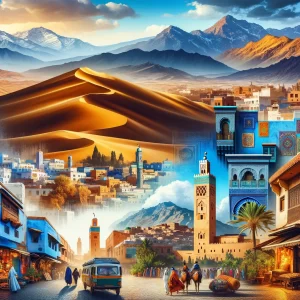
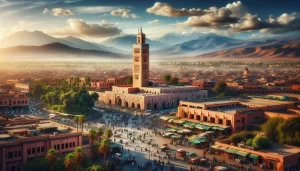
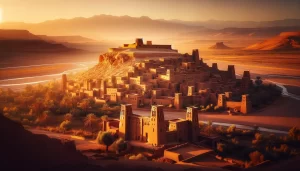
 Embarquez pour un voyage à travers les paysages enchanteurs du Maroc, des dunes ondulantes du désert du Sahara aux rues bleues et sereines de Chefchaouen. Explorez d’anciennes médinas, des montagnes majestueuses et des villes animées, chacune offrant un mélange unique de culture, d’histoire et de beauté naturelle. Que vous soyez à la recherche d’aventure dans les montagnes de l’Atlas, de détente sur les plages balayées par le vent d’Essaouira ou de l’énergie animée des marchés de Marrakech, le Maroc vous attend pour captiver vos sens et créer des souvenirs inoubliables.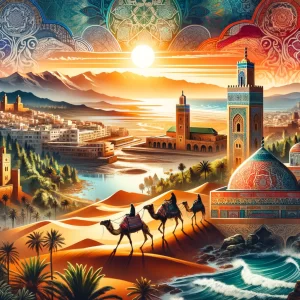

United Kingdom History, Population, Map, Flag, Capital, & Facts
Healthcare in the United Kingdom is a devolved matter and each country has its own system of universal publicly funded healthcare (NHS England, NHS Scotland, Health and Social Care (Northern Ireland) and NHS Wales), although private healthcare is also available. The modern system of universal publicly funded healthcare in the United Kingdom has its origins in the creation of the National Health Service (NHS) in 1949 is the primary healthcare provider in the United Kingdom. About 38 per cent of the United Kingdom https://uk.trustpilot.com/review/no-wageringcasino.com population has a university or college degree, the highest percentage in Europe and one of the highest in the world. Education in the United Kingdom is a devolved matter, with each country having a separate education system.
The UK has a history of non-white immigration with Liverpool having the oldest black population in the country dating from at least the 1730s, in addition to having the oldest Chinese community in Europe dating from the 19th century. The 2011 census also showed that, over the previous 100 years, the proportion of the population aged 0–14 fell from 31 to 18 per cent, and the proportion of people aged 65 and over rose from 5 to 16 per cent. In 2012 and 2013 births contributed the most to population growth, while in 2014 and 2015 net international migration contributed more. In the late 1990s nuclear power plants contributed around 25 per cent of the total annual electricity generation in the UK, but this has gradually declined as old plants have been shut down. Wind power was the largest source of electricity in 2024, generating 30 per cent of the UK’s total electricity. It is home to many large energy companies, including two of the six major oil and gas companies – BP and Shell.
- In 2015 the UK published 2,710 book titles per million inhabitants, more than any other country, with much of this exported to other Anglophone countries.
- The food of England has historically been characterised by simplicity of approach and a reliance on the high quality of natural produce.
- Whether you’re launching a business, expanding into the UK, or securing a premium digital asset, .UK.COM is the smart choice for international success.
- Local government in Northern Ireland since 1973 has been organised into 26 district councils, each elected by single transferable vote.
They are active and regular participants in NATO (including the Allied Rapid Reaction Corps), the Five Power Defence Arrangements, RIMPAC and other worldwide coalition operations. Britain’s global presence and influence is further amplified through its trading relations, foreign investments, official development assistance and military engagements. It maintains the British Council, an organisation specialising in international cultural and educational opportunities in over 100 countries. Local government in Northern Ireland since 2015 has been divided between 11 councils with limited responsibilities. It established power sharing arrangements for a devolved government and legislature, referred to as the Northern Ireland Executive and the Northern Ireland Assembly respectively.
SEAMLESS EXPANSION FOR BUSINESSES & STARTUPS
From the late 1960s, Northern Ireland experienced communal and paramilitary violence, sometimes affecting other parts of the UK, known as the Troubles. Over the next three decades, most colonies of the British Empire gained their independence, and many became members of the Commonwealth of Nations. Britain had still not recovered from the effects of the First World War when the Great Depression (1929–1932) led to considerable unemployment and hardship in the old industrial areas, as well as political and social unrest with rising membership in communist and socialist parties. A period of conflict in what is now Northern Ireland occurred from June 1920 until June 1922. By the mid-1920s most of the British population could listen to BBC radio programmes. Under the leadership of David Lloyd George, the British Empire reached its greatest extent, covering a fifth of the world’s land surface and a quarter of its population.
United Kingdom of Great Britain and Ireland
During this time Canada, Australia and New Zealand were granted self-governing dominion status. The British population increased at a dramatic rate, accompanied by rapid urbanisation, causing significant social and economic stresses. Throughout the Victorian era (1837–1901) political attitudes favoured free trade and laissez-faire policies. British merchants played a leading part in the Atlantic slave trade, mainly between 1662 and 1807 when British or British-colonial slave ships transported nearly 3.3 million slaves from Africa.
The United Kingdom hosted the Summer Olympic Games in 1908, 1948 and 2012, with London acting as the host city on all three occasions. England, Scotland, Wales, Ireland, France and Italy compete in the Six Nations Championship, the premier international rugby union tournament in the northern hemisphere. The sport was created in Rugby School, Warwickshire, and the first rugby international took place on 27 March 1871 between England and Scotland.
The London bus network is extensive, with over 6,800 scheduled services every weekday carrying about 6 million passengers on over 700 different routes, making it one of the most extensive bus systems in the world and the largest in Europe. Another major infrastructure project is High Speed 2 (HS2), a high-speed railway under construction since 2019. England and Scotland were leading centres of the Scientific Revolution from the 17th century. It is rich in a variety of other natural resources including coal, petroleum, natural gas, tin, limestone, iron ore, salt, clay, chalk, gypsum, lead, and silica and has an abundance of arable land. The UK is one of Europe’s leading retail markets and its largest e-commerce market. The country’s tourism sector is important to the British economy; The creative industries accounted for 5.9 per cent of the UK’s GVA in 2019, and contributed £111 billion to the UK economy in 2018.